
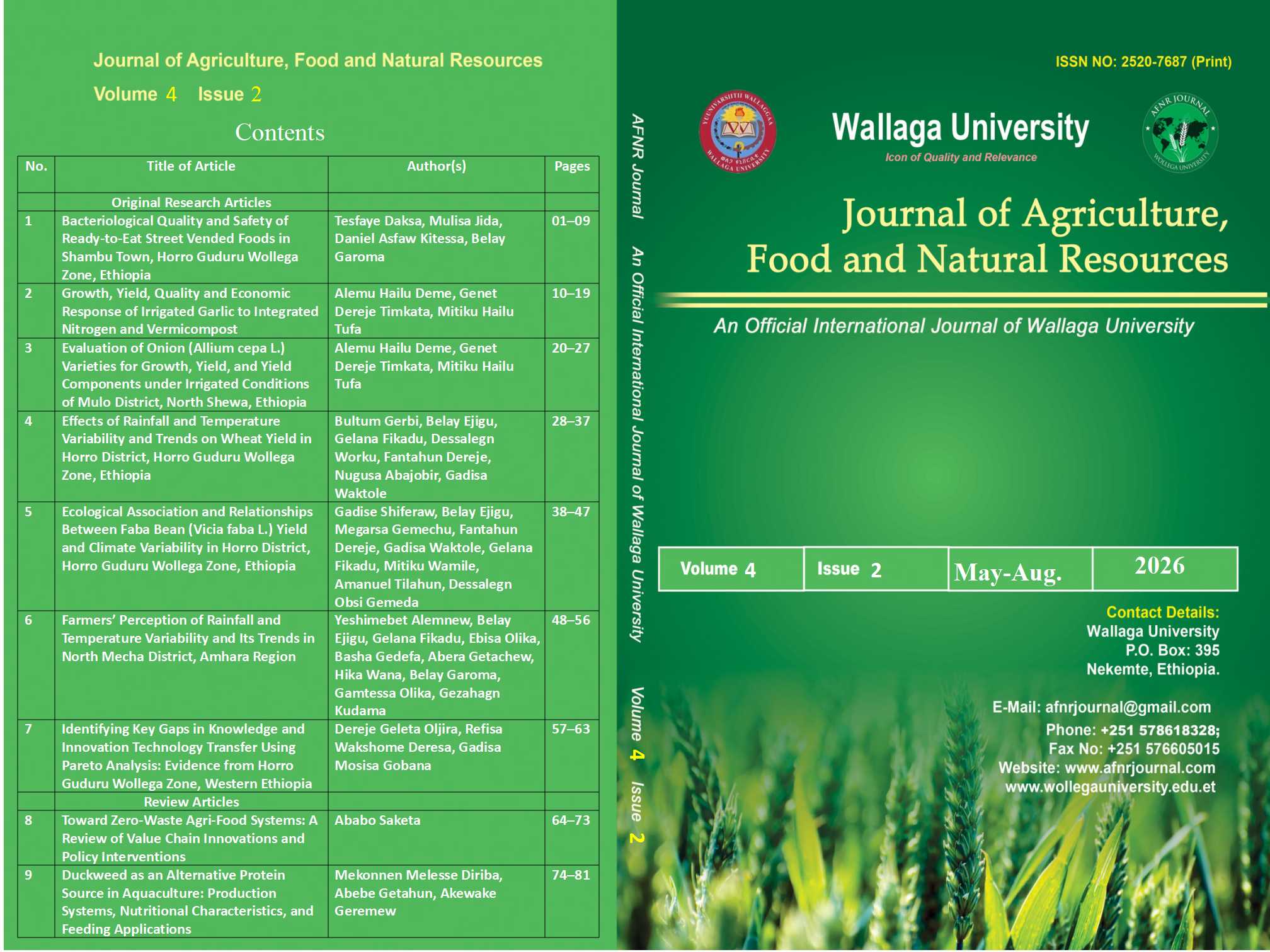
Toward Zero-Waste Agri-Food Systems: A Review of Value Chain Innovations and Policy Interventions
DOI:
https://doi.org/10.20372/afnr.v4i2.2120Keywords:
agri-food systems, circular economy, Food waste, policy interventions, Zero wasteAbstract
Global agri-food systems lose or waste approximately one-third of the food produced for human consumption every year, with substantial economic, environmental, and social costs. This paper presents a systematic literature review of value chain innovations and policy interventions that support the transition to zero-waste agri-food systems. Following a structured search and screening process, thirty peer-reviewed studies published between 2020 and 2026 were analyzed and synthesized thematically. Three interconnected clusters of innovation emerged. The first, technological valorization, encompasses green extraction technologies, bio-refining, and microbial valorization of agri-food by-products. The second, retail and redistribution strategies, includes the commercialization of imperfect produce and food rescue programs. The third, policy instruments, spans date-label regulation and multi-capital sustainability frameworks. Across these clusters, the evidence shows that technological solutions remain concentrated at the laboratory scale, retail interventions can produce unintended waste-shifting effects, and policy instruments have had, at best, mixed effectiveness. The review further finds that research on zero-waste transitions is disproportionately concentrated in high-income countries, and that social equity considerations remain underrepresented relative to environmental and economic ones. This review concludes that zero-waste agri-food systems will only be achieved through integrated value chain strategies that combine technological innovation with coherent, context-specific policy packages, rather than through technology or policy applied in isolation.
Downloads
Metrics
References
Abbasi-Parizad, P., De Nisi, P., Scaglia, B., Scarafoni, A., Pilu, S., & Adani, F. (2021). Recovery of phenolic compounds from agro-industrial by-products: Evaluating antiradical activities and immunomodulatory properties. Food and Bioproducts Processing, 127, 338–348. https://doi.org/10.1016/j.fbp.2021.03.015
Abd-Elsalam, K. A., Periakaruppan, R., & Rajeshkumar, S. (2021). Agri-waste and microbes for production of sustainable nanomaterials. Elsevier.
Acosta-Fernández, R., Poerio, T., Nabarlatz, D., Giorno, L., & Mazzei, R. (2020). Enzymatic hydrolysis of xylan from coffee parchment in membrane bioreactors. Industrial & Engineering Chemistry Research, 59(16), 7346–7354. https://doi.org/10.1021/acs.iecr.9b06429
Adesra, A., Srivastava, V. K., & Varjani, S. (2021). Valorization of dairy wastes: Integrative approaches for value added products. Indian Journal of Microbiology, 61(3), 270–278. https://doi.org/10.1007/s12088-021-00943-5
Ageeva, N. M., Tikhonova, A. N., & Globa, E. V. (2022). Biotechnologies used to deal with recycling of grape pomace. IOP Conference Series: Earth and Environmental Science, 1052(1), 012102. https://doi.org/10.1088/1755-1315/1052/1/012102
Andika, A., Perdana, T., Chaerani, D., & Utomo, D. S. (2025). Transitioning towards zero waste in the agri-food supply chain: a review of sustainable circular agri-food supply chain. Sustainable Futures, 10, 100917. https://doi.org/10.1016/j.sftr.2025.100917
Alaybek, B., Mika, G., Aitken, J. A., Hartman, R., Painter, J., Broad Leib, E. M., Plekenpol, R., Beckmann, J. S., Leets, L., & Sprenger, A. (2025). Can food waste policies promote sustainability? Relationships of food date label policies with food waste and safety outcomes. Sustainability, 17(6), 2630. https://doi.org/10.3390/su17062630
Amamou, A., Chabouh, S., Dammak, L., Zouari, A., & Mami, A. (2025). Agri-food supply chain sustainability indicators from a multi-capital perspective: A systematic review. Sustainability, 17(9), 4174. https://doi.org/10.3390/su17094174
Belkozhayev, A. M., Abaildayev, A., Kossalbayev, B. D., Tastambek, K. T., Kadirshe, D. K., & Toleutay, G. (2025). Microbial valorization of agricultural and agro-industrial waste into bacterial cellulose: Innovations for circular bioeconomy integration. Microorganisms, 13(12), 2686. https://doi.org/10.3390/microorganisms13122686
Bishop, G., Girón-Domínguez, C., Gaffey, J., Henchion, M., Fealy, R., Zimmermann, J., Kargupta, W., & Styles, D. (2025). A life cycle thinking-based environmental risk framework for screening sustainable feedstocks in early-stage bioeconomy projects. Resources, Environment and Sustainability, 20, 100201. https://doi.org/10.1016/j.resenv.2025.100201
Akhter, S. R., & Ceustermans, S. (2026). Circular Economy Practices and Barriers within European SMEs in the Construction Sector. European Journal of Sustainable Development, 15(1), 53. https://doi.org/10.14207/ejsd.2026.v15n1p53
Castagna, A., Aboudia, A., Guendouz, A., Scieuzo, C., Falabella, P., Matthes, J., Schmid, M., Drissner, D., Allais, F., Chadni, M., Cravotto, C., Senge, J., Krupitzer, C., Canesi, I., Spinelli, D., Drira, F., Hlima, H. B., Abdelkafi, S., Konstantinou, I., . . . Coltelli, M. (2025). Transforming Agricultural Waste from Mediterranean Fruits into Renewable Materials and Products with a Circular and Digital Approach. Materials, 18(7), 1464. https://doi.org/10.3390/ma18071464
Dhiman, S., Thakur, B., Kaur, S., Ahuja, M., Gantayat, S., Sarkar, S., Singh, R., & Tripathi, M. (2025). Closing the loop: technological innovations in food waste valorisation for global sustainability. Discover Sustainability, 6(1). https://doi.org/10.1007/s43621-025-01073-4
FAO (Food and Agriculture Organization of the United Nations). (2013). Food wastage footprint: Impacts on natural resources. FAO.
FAO, IFAD, UNICEF, WFP, & WHO. (2017). The State of Food Security and Nutrition in the World 2017. FAO.
Gómez-García, R., Campos, D. A., Aguilar, C. N., Madureira, A. R., & Pintado, M. (2021). Valorisation of food agro-industrial by-products: From the past to the present and perspectives. Journal of Environmental Management, 299, 113571.
Ingallina, C., Spano, M., Prencipe, S. A., Vinci, G., Di Sotto, A., Ambroselli, D., Vergine, V., Crestoni, M. E., Di Meo, C., Zoratto, N., Izzo, L., Navarré, A., Adiletta, G., Russo, P., Di Matteo, G., Mannina, L., & Giusti, A. M. (2025). Enhancing Human Health Through Nutrient and Bioactive Compound Recovery from Agri-Food By-Products: A Decade of Progress. Nutrients, 17(15), 2528. https://doi.org/10.3390/nu17152528
Kazaz, B., Xu, F., & Yu, H. (2025). Retailing strategies of imperfect produce and the battle against food waste. Manufacturing & Service Operations Management. https://doi.org/10.1287/msom.2023.0167
Landrigan, P. J., Raps, H., Cropper, M., Bald, C., Brunner, M., Canonizado, E. M., Charles, D., Chiles, T. C., Donohue, M. J., Enck, J., Fenichel, P., Fleming, L. E., Ferrier-Pages, C., Fordham, R., Gozt, A., Griffin, C., Hahn, M. E., Haryanto, B., Hixson, R., . . . Dunlop, S. (2023). The Minderoo-Monaco Commission on Plastics and Human Health. Annals of Global Health, 89(1), 23. https://doi.org/10.5334/aogh.4056
Ligarda-Samanez, C. A., Huamán-Carrión, M. L., Calsina-Ponce, W. C., De La Cruz, G., Huamaní, D. F. C., Cabel-Moscoso, D. J., Garcia-Espinoza, A. J., Sucari-León, R., Aroquipa-Durán, Y., Muñoz-Saenz, J. C., Muñoz-Melgarejo, M., & Jilaja-Carita, E. E. (2025). Technological Innovations and Circular Economy in the Valorization of Agri-Food By-Products: Advances, challenges and Perspectives. Foods, 14(11), 1950. https://doi.org/10.3390/foods14111950
Liudvytska, O., Kowalczyk, M., Krzyżanowska-Kowalczyk, J., Michaś, K., Michalak, M., Balcerczyk, A., Skowrońska, W., Równicki, M., Bazylko, A., Olszewska, M. A., & Kolodziejczyk-Czepas, J. (2025). Phytochemical Profiling, Anti-Inflammatory Action, and Human Gut Microbiota-Assisted Digestion of Rheum officinale Petiole and Root Extracts An In Vitro Study. Nutrients, 17(21), 3455. https://doi.org/10.3390/nu17213455
Neves, C. M. B., Fogeiro, É., Cardoso, S. M., Gonçalves, F., Pinto, A., & Wessel, D. F. (2024). Towards the valorization of elderberry by-product: Recovery and use of natural ingredients for sorbet formulations. Applied Sciences, 14(22), 10328. https://doi.org/10.3390/app142210328
Olauson Barlas, C., Martin, W., & Fonseca-Cuevas, A. (2025). Retail food loss and waste reduction interventions: A scoping review. Journal of Agriculture, Food Systems, and Community Development, 14(2), 145–164. https://doi.org/10.5304/jafscd.2025.142.027
Osorio, L. L. D. R., Flórez-López, E., & Grande-Tovar, C. D. (2021). The potential of selected agri-food loss and waste to contribute to a circular economy: Applications in the food, cosmetic and pharmaceutical industries. Molecules, 26(2), 515. https://doi.org/10.3390/molecules26020515
Pandey, A. K., Thakur, S., Mehra, R., Kaler, R. S. S., Paul, M., & Kumar, A. (2025). Transforming Agri-food waste: Innovative pathways toward a zero-waste circular economy. Food Chemistry X, 28, 102604. https://doi.org/10.1016/j.fochx.2025.102604
Pandhi, S., Mahato, D. K., Kurian, A., Pandey, S., Thamarai, A., Gaur, V., Kamle, M., Shukla, A. C., & Kumar, P. (2025). Transforming agri-food waste into value: Sustainable approaches for next-generation resistant starch production. Bioresource Technology, 437, 133090. https://doi.org/10.1016/j.biortech.2025.133090
Pothimoi, S., Seesuriyachan, P., Chaiyaso, T., Insomphun, C., Yakul, K., Phimolsiripol, Y., & Moukamnerd, C. (2026). Enhanced sensory, antioxidant, and non-toxic anti-diabetes beverage development via co-culture fermentation in coffee cherry pulp extracts. Food Chemistry: X, 33, 103524. https://doi.org/10.1016/j.fochx.2026.103524
Shawky, E., Gibbons, S., & Selim, D. A. (2025). Bio-sourcing from byproducts: A comprehensive review of bioactive molecules in agri-food waste streams for valorization and sustainable applications. Bioresource Technology, 431, 132640. https://doi.org/10.1016/j.biortech.2025.132640
Dammak, K., Zouari, A., & Dammak, L. (2025). Integrating multi capital approaches for enhancing sustainability in agri-food supply chains. Discover Sustainability, 6(1). https://doi.org/10.1007/s43621-025-02028-5
UNEP (United Nations Environment Programme). (2024). Food Waste Index Report 2024. UNEP.
Venkataraman, S., & Sundramoorthy, A. K. (2026). Waste-derived carbon nanomaterials for electrochemical applications: Toward a circular and sustainable future. RSC Advances, 16(1), 733–747. https://doi.org/10.1039/d5ra08357e
Wilson, N. L. W., & Miao, R. (2025). Food waste, date labels, and risk preferences: An experimental exploration. Applied Economic Perspectives and Policy, 47(3), 1029–1057. https://doi.org/10.1002/aepp.13507
Won, H. J., & Choi, A. J. (2025). Optimization of pre-treatments to overcome stickiness-related hurdles and enhance drying efficiency in apple pomace. Food Science & Nutrition, 13(11), e70988. https://doi.org/10.1002/fsn3.70988
World Bank & FAO. (2011). Missing food: The case of postharvest grain losses in sub-Saharan Africa. World Bank.
Downloads
Published
How to Cite
Issue
Section
Categories
License
Copyright (c) 2026 Journal of Agriculture, Food and Natural Resources

This work is licensed under a Creative Commons Attribution-NonCommercial 4.0 International License.
Journal of Agriculture, Food and Natural Resources
Wallaga University,
All rights reserved.
Accepted 2026-08-29
Published 2026-08-31


