
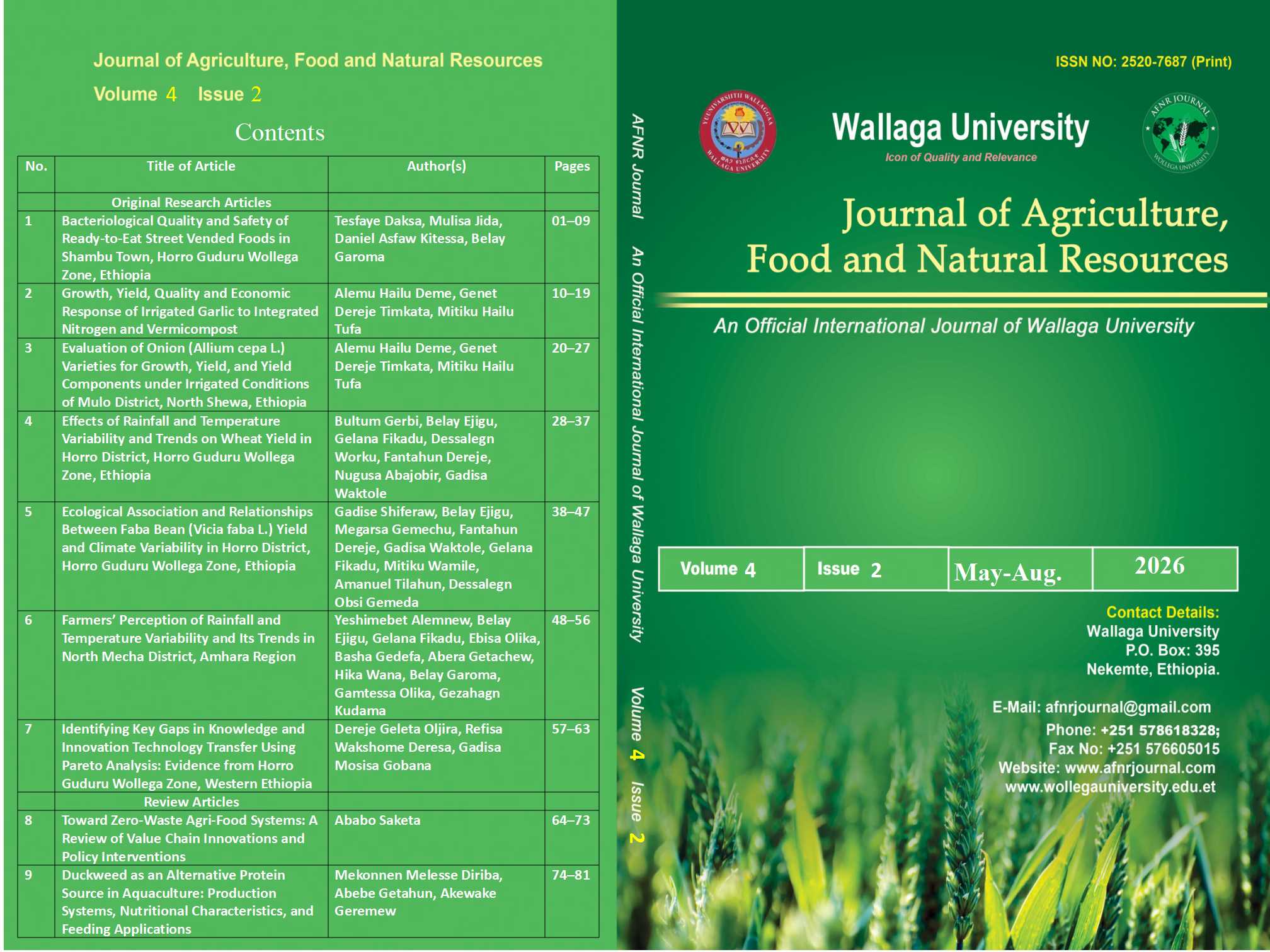
Duckweed as an Alternative Protein Source in Aquaculture: Production Systems, Nutritional Characteristics, and Feeding Applications
DOI:
https://doi.org/10.20372/afnr.v4i2.2155Abstract
The growth of global aquaculture has led to an increasing demand for sustainable, nutritionally adequate, and cost-effective alternatives to conventional fishmeal-based aquafeeds. Fishmeal remains a valuable protein source; however, its supply is limited and cost and environmental impact are increasing. Therefore, the search for alternative feed ingredients is expanding. Duckweed (Lemnaceae) is a promising candidate because of its rapid growth, high protein content, amino acid profile, and ability to recover nutrients from wastewater. This narrative review integrates the existing knowledge on production systems, their nutritional profile, and presence of anti-nutritional factors, feed safety, economic viability, and uses in aquaculture. Literature published between 1990 and 2026 was obtained from major databases, including PubMed, Scopus, Web of Science, DOAJ, and Google Scholar, using keywords related to duckweed, aquaculture, fish nutrition, fishmeal replacement, and sustainable aquafeeds. Reviewed feeding trials indicate that dietary inclusion levels of 15-30% generally allow good growth performance, feed conversion efficiency, and survival in several omnivorous and herbivorous fish species, especially Nile tilapia, common carp, and grass carp. Duckweed contains 15-45% crude protein with relatively balanced amino acid profile, but the nutritional composition varies among species and cultivation conditions. The main constraints are anti-nutritional compounds, variability in nutrient composition, heavy metal accumulation when cultivated in contaminated wastewater, drying costs, and regulatory challenges. Current evidence supports duckweed as partial replacement for conventional protein ingredients. Future research should focus on feed safety, production standardization, processing technologies, long-term feeding trials, and commercial-scale economic evaluation to wider adoption in sustainable aquaculture systems.
Downloads
Metrics
References
Alkhamis, Y. A. (2024). Effect of Aquaponically Grown Duckweed as a Sustainable Feed on Growth Indices, Water Quality, and Digestive Activities, for the Nile Tilapia Reared in Aquaponic Culture. Egyptian Journal of Aquatic Biology and Fisheries, 28(2), 631–646. https://doi.org/10.21608/ejabf.2024.350076
Allergens, E. P. O. N. N. F. a. F., Turck, D., Castenmiller, J., De Henauw, S., Hirsch‐Ernst, K. I., Kearney, J., Maciuk, A., Mangelsdorf, I., McArdle, H. J., Naska, A., Pelaez, C., Pentieva, K., Siani, A., Thies, F., Tsabouri, S., Vinceti, M., Cubadda, F., Frenzel, T., Heinonen, M., . . . Knutsen, H. K. (2021). Safety of oil from Schizochytrium limacinum (strain FCC‐3204) for use in food supplements as a novel food pursuant to Regulation (EU) 2015/2283. EFSA Journal, 19(1), e06345. https://doi.org/10.2903/j.efsa.2021.6345
Appenroth, K.-J., Sree, K. S., Böhm, V., Hammann, S., Vetter, W., Leiterer, M., & Jahreis, G. (2017). Nutritional value of duckweeds (Lemnaceae) as human food. Food Chemistry, 217, 266–273.
Bennett, A., Patil, P., Kleisner, K., Rader, D., Virdin, J., & Basurto, X. (2018). Contribution of fisheries to food and nutrition security: Current knowledge, policy, and research. NI Report, 18(2). https://nicholasinstitute.duke.edu/sites/default/files/publications/contribution_of_fisheries_to_food_and_nutrition_security.pdf
Bog, M., Appenroth, K.-J., & Sree, K. S. (2019). Duckweed (Lemnaceae): Its molecular taxonomy. Frontiers in Sustainable Food Systems, 3, 117.
Braglia, L., Lauria, M., Appenroth, K. J., Bog, M., Breviario, D., Grasso, A., Gavazzi, F., & Morello, L. (2021). Duckweed species genotyping and interspecific hybrid discovery by tubulin-based polymorphism fingerprinting. Frontiers in Plant Science, 12, 625670.
Cabrera, L. I., Salazar, G. A., Chase, M. W., Mayo, S. J., Bogner, J., & Dávila, P. (2008). Phylogenetic relationships of aroids and duckweeds (Araceae) inferred from coding and noncoding plastid DNA. American Journal of Botany, 95(9), 1153–1165. https://doi.org/10.3732/ajb.0800073
Duman, F., Ozturk, F., & Aydin, Z. (2010). Biological responses of duckweed (Lemna minor L.) exposed to the inorganic arsenic species As(III) and As(V): Effects of concentration and duration of exposure. Ecotoxicology, 19(5), 983–993. https://doi.org/10.1007/s10646-010-0480-5
Effiong, E. M. (2019). REPOSITORY OF INNOVATION AND STUDIES. Retrieved August 10, 2026, from https://innovationandstudies.royal.ng/library/vol2iss2ent6=lemna-dump-site-crs.pdf
Fasakin, E. A., Balogun, A. M., & Fasuru, B. E. (1999). Use of duckweed, Spirodela polyrrhiza L. Schleiden, as a protein feedstuff in practical diets for tilapia, Oreochromis niloticus L.: Duckweed as a protein feedstuff for tilapia E A Fasakin et al . Aquaculture Research, 30(5), 313–318. https://doi.org/10.1046/j.1365-2109.1999.00318.x
Glencross, B. D. (2020). A feed is still only as good as its ingredients: An update on the nutritional research strategies for the optimal evaluation of ingredients for aquaculture feeds. Aquaculture Nutrition, 26(6), 1871–1883. https://doi.org/10.1111/anu.13138
Hardy, R. W. (2010). Utilization of plant proteins in fish diets: Effects of global demand and supplies of fishmeal. Aquaculture Research, 41(5), 770–776. https://doi.org/10.1111/j.1365-2109.2009.02349.x
Hedden, S., Hughes, B., Rothman, D. S., Markle, A. J., & Maweni, J. (2021). Ending hunger in Africa: The elimination of hunger and food insecurity on the African continent by 2025-conditions for success. Available at SSRN 3941433. https://papers.ssrn.com/sol3/papers.cfm?abstract_id=3941433
Hiththatiyage, R., Senevirathne, S., Wickramasinghe, M., Rathnayaka, I., Madhujith, T., Jayawardana, B., Wijesundara, S., & Liyanage, R. (2026). Nutritional composition and bioactive properties of four duckweed species in Sri Lanka. BMC Agriculture, 2(1), 18. https://doi.org/10.1186/s44399-026-00043-z
Hua, K., Cobcroft, J. M., Cole, A., Condon, K., Jerry, D. R., Mangott, A., Praeger, C., Vucko, M. J., Zeng, C., & Zenger, K. (2019). The future of aquatic protein: Implications for protein sources in aquaculture diets. One Earth, 1(3), 316–329.
Krogdahl, Å., Penn, M., Thorsen, J., Refstie, S., & Bakke, A. M. (2010). Important antinutrients in plant feedstuffs for aquaculture: An update on recent findings regarding responses in salmonids. Aquaculture Research, 41(3), 333–344. https://doi.org/10.1111/j.1365-2109.2009.02426.x
Leng, R. A. (1999). Duckweed: A tiny aquatic plant with enormous potential for agriculture and environment. https://agris.fao.org/search/en/providers/122621/records/647241c408fd68d546003fd2
Leng, R. A., Stambolie, J. H., & Bell, R. (1995). Duckweed-a potential high-protein feed resource for domestic animals and fish. Livestock Research for Rural Development, 7(1), 36.
Les, D. H., Crawford, D. J., Landolt, E., Gabel, J. D., & Kimball, R. T. (2002). Phylogeny and systematics of Lemnaceae, the duckweed family. Systematic Botany, 27(2), 221–240.
Liu, Y., Xu, H., Yu, C., & Zhou, G. (2021). Multifaceted roles of duckweed in aquatic phytoremediation and bioproducts synthesis. GCB Bioenergy, 13(1), 70–82. https://doi.org/10.1111/gcbb.12747
Majluf, P., Matthews, K., Pauly, D., Skerritt, D. J., & Palomares, M. L. D. (2024). A review of the global use of fishmeal and fish oil and the Fish In:Fish Out metric. Science Advances, 10(42), eadn5650. https://doi.org/10.1126/sciadv.adn5650
Makkar, H. P. S., Francis, G., & Becker, K. (2007). Bioactivity of phytochemicals in some lesser-known plants and their effects and potential applications in livestock and aquaculture production systems. Animal, 1(9), 1371–1391. https://doi.org/10.1017/S1751731107000298
Miltko, R., Majewska, M. P., Wojtak, W., Białek, M., Kowalik, B., & Czauderna, M. (2024). Comparing the chemical composition of lesser duckweed (Lemna minor L.) grown in natural and laboratory settings. Journal of Animal and Feed Sciences, 33(3), 357–367.
Minich, J. J., & Michael, T. P. (2024). A review of using duckweed (Lemnaceae) in fish feeds. Reviews in Aquaculture, 16(3), 1212–1228. https://doi.org/10.1111/raq.12892
Mkandawire, M., & Dudel, E. G. (2005). Accumulation of arsenic in Lemna gibba L.(duckweed) in tailing waters of two abandoned uranium mining sites in Saxony, Germany. Science of the Total Environment, 336(1–3), 81–89.
Mukherjee, S., Mukherjee, S., Bhattacharyya, P., & Duttagupta, A. K. (2004). Heavy metal levels and esterase variations between metal-exposed and unexposed duckweed Lemna minor: Field and laboratory studies. Environment International, 30(6), 811–814. https://doi.org/10.1016/j.envint.2004.01.006
Muller, T., Cournoyer, A., & Bazinet, L. (2025). Emerging potentials of duckweed (Lemnaceae): From composition to protein uses in food and nutraceuticals–A review. Food Research International, 219, 116777.
Naylor, R. L., Hardy, R. W., Buschmann, A. H., Bush, S. R., Cao, L., Klinger, D. H., Little, D. C., Lubchenco, J., Shumway, S. E., & Troell, M. (2021). A 20-year retrospective review of global aquaculture. Nature, 591(7851), 551–563. https://doi.org/10.1038/s41586-021-03308-6
NRC., N. (2011). Nutrient Requirements of Fish and Shrimp. National Academies Press.
Nunoo, F. K. E., Asamoah, E. K., & Osei-Asare, Y. B. (2014). Economics of aquaculture production: A case study of pond and pen culture in southern Ghana. Aquaculture Research, 45(4), 675–688. https://doi.org/10.1111/are.12003
Rahman, M. A., Hasegawa, H., Ueda, K., Maki, T., Okumura, C., & Rahman, M. M. (2007). Arsenic accumulation in duckweed (Spirodela polyrhiza L.): A good option for phytoremediation. Chemosphere, 69(3), 493–499.
Rifai, A. A., & Permata, F. S. (2023). The Potency of BSF Maggot Culture for Green Economic Resilience. 700–709. https://doi.org/10.2991/978-94-6463-140-1_70
Rifai, R. M., Yulistyorini, A., Siswahyudi, D., Pratiwi, J. R., Fauzi, I. A., & Rachminiwati, N. (2024). A kinetic approach for employing two duckweed species, Lemna minor, and Spirodela polyrhiza, in the sustainable aquaculture wastewater treatment and fish feed production. https://www.cabidigitallibrary.org/doi/full/10.5555/20250131541
Shah, M. R., Lutzu, G. A., Alam, A., Sarker, P., Kabir Chowdhury, M. A., Parsaeimehr, A., Liang, Y., & Daroch, M. (2018). Microalgae in aquafeeds for a sustainable aquaculture industry. Journal of Applied Phycology, 30(1), 197–213. https://doi.org/10.1007/s10811-017-1234-z
Shepherd, C. J., & Jackson, A. J. (2013). Global fishmeal and fish‐oil supply: Inputs, outputs and marketsa. Journal of Fish Biology, 83(4), 1046–1066. https://doi.org/10.1111/jfb.12224
Skillicorn, P., Spira, W., & Journey, W. (1993). Duckweed aquaculture: A new aquatic farming system for developing countries. https://www.cabidigitallibrary.org/doi/full/10.5555/19931858419
Song, Y., Hu, Z., Yang, X., An, Y., & Lu, Y. (2025). Duckweed as a Sustainable Aquafeed: Effects on Growth, Muscle Composition, Antioxidant and Immune Markers in Grass Carp. Animals, 16(1), 53.
Song, Y., Luo, S., Li, S., Yang, X., He, R., Hu, Z., Yang, X., & Lu, Y. (2026). Duckweed (Lemnaceae) as a Functional Protein Ingredient in Koi Carp Diets: Species‐Dependent Effects on Growth, Pigmentation, Antioxidant Status, and Gut Health. Aquaculture Nutrition, 2026(1), 3873558. https://doi.org/10.1155/anu/3873558
Spranghers, T., Ottoboni, M., Klootwijk, C., Ovyn, A., Deboosere, S., De Meulenaer, B., Michiels, J., Eeckhout, M., De Clercq, P., & De Smet, S. (2017). Nutritional composition of black soldier fly ( Hermetia illucens ) prepupae reared on different organic waste substrates. Journal of the Science of Food and Agriculture, 97(8), 2594–2600. https://doi.org/10.1002/jsfa.8081.
Sree, K., Bog, M., & Appenroth, K. (2016). Taxonomy of duckweeds (Lemnaceae), potential new crop plants. Emirates Journal of Food and Agriculture, 28(5), 291. https://doi.org/10.9755/ejfa.2016-01-038
Sree, K. S., & Appenroth, K.-J. (2020). Worldwide Genetic Resources of Duckweed: Stock Collections. In X. H. Cao, P. Fourounjian, & W. Wang (Eds.), The Duckweed Genomes (pp. 39–46). Springer International Publishing. https://doi.org/10.1007/978-3-030-11045-1_3
Tacon, A. G. J., & Metian, M. (2018). Food Matters: Fish, Income, and Food Supply—A Comparative Analysis. Reviews in Fisheries Science & Aquaculture, 26(1), 15–28. https://doi.org/10.1080/23308249.2017.1328659
Van Der Spiegel, M., Noordam, M. Y., & Van Der Fels‐Klerx, H. J. (2013). Safety of Novel Protein Sources (Insects, Microalgae, Seaweed, Duckweed, and Rapeseed) and Legislative Aspects for Their Application in Food and Feed Production. Comprehensive Reviews in Food Science and Food Safety, 12(6), 662–678. https://doi.org/10.1111/1541-4337.12032
Van Huis, A. (2020). Insects as food and feed, a new emerging agricultural sector: A review. Journal of Insects as Food and Feed, 6(1), 27–44. https://doi.org/10.3920/JIFF2019.0017
Wang, W., Wu, Y., Yan, Y., Ermakova, M., Kerstetter, R., & Messing, J. (2010). DNA barcoding of the Lemnaceae, a family of aquatic monocots. BMC Plant Biology, 10(1), 205. https://doi.org/10.1186/1471-2229-10-205
Yang, G.-L., Feng, D., Liu, Y.-T., Lv, S.-M., Zheng, M.-M., & Tan, A.-J. (2021). Research progress of a potential bioreactor: Duckweed. Biomolecules, 11(1), 93.
Yin, G.-M., Yang, L., Li, S., & Zhang, Y. (2026). Duckweeds: From fundamental biology to a sustainable plant chassis for biotechnology. Advanced Biotechnology, 4(2), 16. https://doi.org/10.1007/s44307-026-00110-1
Zhou, Y., Stepanenko, A., Kishchenko, O., Xu, J., & Borisjuk, N. (2023). Duckweeds for Phytoremediation of Polluted Water. Plants, 12(3), 589. https://doi.org/10.3390/plants12030589
Downloads
Published
How to Cite
Issue
Section
Categories
License
Copyright (c) 2026 Journal of Agriculture, Food and Natural Resources

This work is licensed under a Creative Commons Attribution-NonCommercial 4.0 International License.
Journal of Agriculture, Food and Natural Resources
Wallaga University,
All rights reserved.
Accepted 2026-08-19
Published 2026-08-31


