
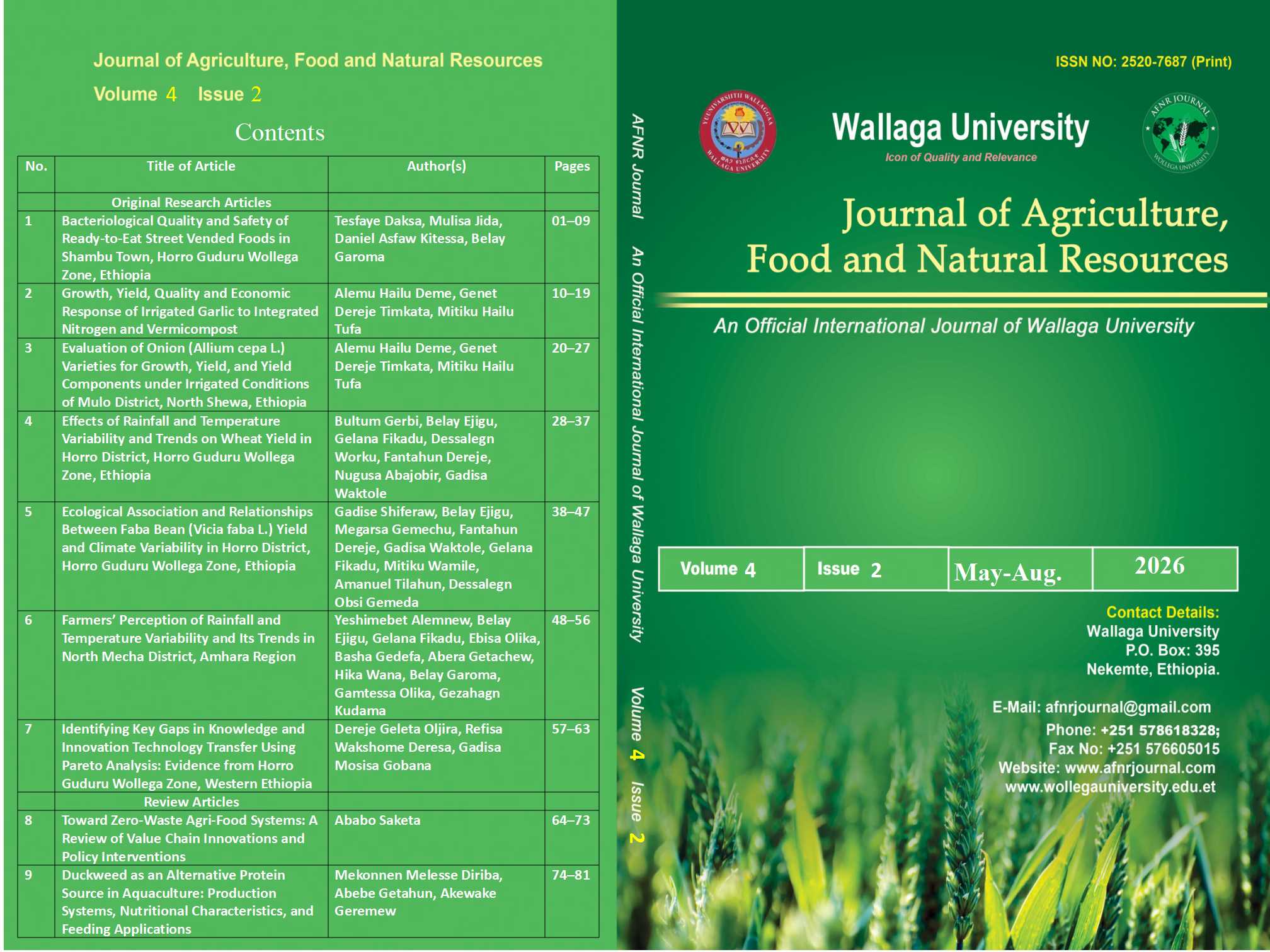
Growth, Yield, Quality and Economic Response of Irrigated Garlic to Integrated Nitrogen and Vermicompost
DOI:
https://doi.org/10.20372/afnr.v4i2.2271Keywords:
Bulb, Growth, Productivity, Vermicompost, YieldAbstract
A field trial was conducted in Mulo District, Ethiopia, during the 2024–2025 off-season to assess the effects of nitrogen and vermicompost on garlic growth, yield, quality, and economic performance. The experiment comprised a 4 × 4 factorial arrangement of four nitrogen rates (0, 50, 100, and 150 kg N ha⁻¹) and four vermicompost rates (0, 2.5, 5.0, and 7.5 t ha⁻¹) in a Randomized Complete Block Design with three replications. Data were analyzed using the GLM of SAS 9.4, and means were separated using Duncan’s Multiple Range Test at the 5% significance level. Nitrogen × vermicompost interaction significantly affected major growth, yield, and quality parameters (P ≤ 0.05). The combined application of 150 kg N ha⁻¹ and 7.5 t vermicompost ha⁻¹ produced highest plant height (80.4 cm), leaves per plant (13.6), leaf length (50.9 cm), leaf diameter (1.72 cm), bulb diameter (5.6 cm), average bulb weight (40.5 g), and bulb yield (11.8 t ha⁻¹), compared with 55.2 cm, 8.5 leaves plant⁻¹, 32.4 cm, 1.10 cm, 2.8 cm, 18.5 g, and 4.2 t ha⁻¹, respectively, in the control. The same treatment recorded the highest total soluble solids (41.3 °Brix), dry matter (32.0%), and storability (140 days), with the lowest moisture content (68.0%). Adjusted bulb yield increased from 3,780 to 10,620 kg ha⁻¹, generating a gross field benefit of ETB 531,000 ha⁻¹. Therefore, 150 kg N ha⁻¹ plus 7.5 t vermicompost ha⁻¹ performed best under irrigated conditions, similar experiments should be conducted across different seasons and locations.
Downloads
Metrics
References
Bouyoucos, G. J. (1962). Hydrometer method improved for making particle size analyses of soils. Agronomy Journal, 54(5), 464–465. https://doi.org/10.2134/agronj1962.00021962005400050028x
Brady, N. C., & Weil, R. R. (2008). The nature and properties of soils (14th ed.). Pearson Education.
Bremner, J. M., & Mulvaney, C. S. (1982). Nitrogen—Total. In A. L. Page (Ed.), Methods of soil analysis: Part 2. Chemical and microbiological properties (2nd ed., pp. 595–624). American Society of Agronomy and Soil Science Society of America. https://doi.org/10.2134/agronmonogr9.2.2ed.c31
Brewster, J. L. (2008). Onions and other vegetable alliums (2nd ed.). CABI.
Chapman, H. D. (1965). Cation-exchange capacity. In C. A. Black (Ed.), Methods of soil analysis: Part 2. Chemical and microbiological properties (pp. 891–900). American Society of Agronomy. https://doi.org/10.2134/agronmonogr9.2.c6
International Maize and Wheat Improvement Center (CIMMYT). (1988). From agronomic data to farmer recommendations: An economics workbook. CIMMYT.
Central Statistical Agency (CSA). (2017). Agricultural sample survey 2016/17 (2009 E.C.): Report on area and production of major crops. Central Statistical Agency, Addis Ababa, Ethiopia.
Edwards, C. A., Arancon, N. Q., & Sherman, R. L. (2010). Vermiculture technology: Earthworms, organic wastes, and environmental management. CRC Press. The three editors are confirmed by the publisher/catalogue record.
Gebre, M., Bekele, T., & Zewide, I. (2025). Growth, yield, and yield components of garlic (Allium sativum L.) as affected by clove weight and intrarow spacing at Semen Bench District, South-West Ethiopia. Advances in Agriculture, 2025, 3481345. https://doi.org/10.1155/aia/3481345
Kenea, S. A., Goshu, T. A., & Chimdessa, K. (2024). Response of garlic (Allium sativum L.) yield to combined biochar, lime, and inorganic-fertilizer rates in the case of Gimbi District, Western Ethiopia. Advances in Agriculture, 2024, 1347367. https://doi.org/10.1155/2024/1347367
Khokhar, K. M. (2023). Bulb development in garlic—a review. The Journal of Horticultural Science and Biotechnology, 98(4), 432–442. https://doi.org/10.1080/14620316.2022.2150326
Lazcano, C., & Domínguez, J. (2011). The use of vermicompost in sustainable agriculture: Impact on plant growth and soil fertility. In M. Miransari (Ed.), Soil nutrients (pp. 230–254). Nova Science Publishers.
Marschner, P. (Ed.). (2012). Marschner's mineral nutrition of higher plants (3rd ed.). Academic Press.
Olsen, S. R., Cole, C. V., Watanabe, F. S., & Dean, L. A. (1954). Estimation of available phosphorus in soils by extraction with sodium bicarbonate. U.S. Department of Agriculture, Circular No. 939. The full authors and publication details are confirmed by the U.S. Department of Agriculture bibliographic record.
Palm, C. A., Myers, R. J. K., & Nandwa, S. M. (1997). Combined use of organic and inorganic nutrient sources for soil fertility maintenance and replenishment. In R. J. Buresh, P. A. Sanchez, & F. Calhoun (Eds.), Replenishing soil fertility in Africa (pp. 193–217). Soil Science Society of America. https://doi.org/10.2136/sssaspecpub51.c8
Walkley, A., & Black, I. A. (1934). An examination of the Degtjareff method for determining soil organic matter, and a proposed modification of the chromic acid titration method. Soil Science, 37(1), 29–38. https://doi.org/10.1097/00010694-193401000-00003
Downloads
Published
How to Cite
Issue
Section
Categories
License
Copyright (c) 2026 Journal of Agriculture, Food and Natural Resources

This work is licensed under a Creative Commons Attribution-NonCommercial 4.0 International License.
Journal of Agriculture, Food and Natural Resources
Wallaga University,
All rights reserved.
Accepted 2026-08-30
Published 2026-08-31


