
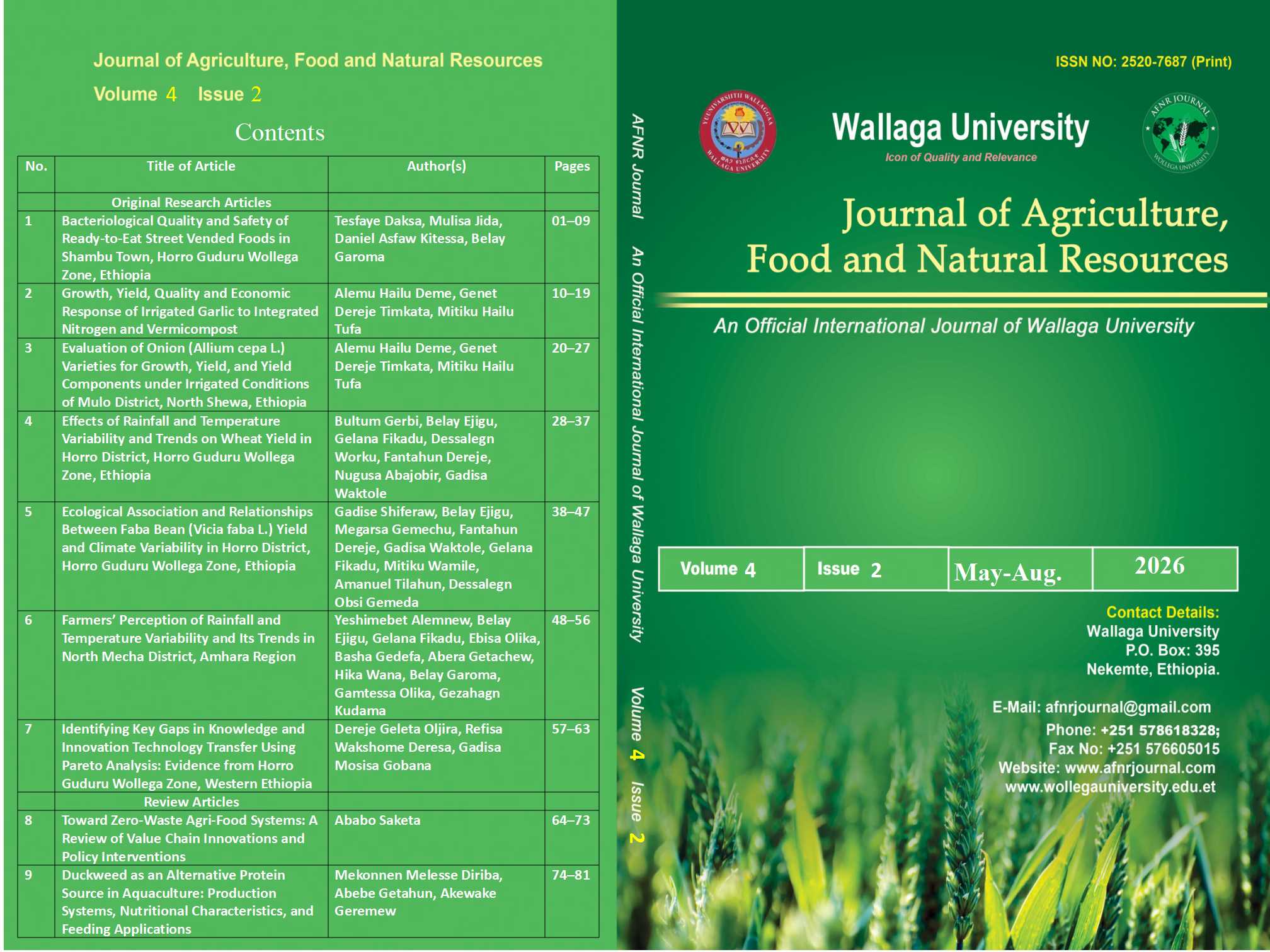
Bacteriological Quality and Safety of Ready-to-Eat Street Vended Foods in Shambu Town, Horro Guduru Wollega Zone, Ethiopia
DOI:
https://doi.org/10.20372/afnr.v4i2.2154Keywords:
Antimicrobial resistance, Food handling practices, Food safety, Street-vended foodsAbstract
Street-vended foods provide affordable nutrition and economic opportunities but may pose significant public health risks when contaminated. This study assessed the food handling procedures, safety, and bacteriological quality of ready-to-eat street foods in Shambu Town, Ethiopia. A cross-sectional investigation was carried out involving N = 91 vendors and 45 food samples that are ready-to-eat (five food types gathered from three vending sites). Aerobic mesophilic bacteria (AMB), aerobic spore-forming bacteria (ASFB), Enterobacteriaceae, coliforms, and Staphylococcus spp. were enumerated using standard microbiological procedures. Bacterial isolates were identified biochemically, and the disk diffusion method was used to assess antimicrobial susceptibility. Most vendors were young (70.33% aged 21–30 years), female (63.73%), and had only primary education (50.55%). Critical food safety violations included food preparation at home without hygiene training (100%), handling food with bare hands (68.13%), failure to wear aprons (95.6%), and vending in dusty environments (65.93%). Mean AMB counts were highest in bread (5.45–5.46 log CFUg-1), while Staphylococcus spp. counts peaked in potato samples (6.40 log CFUg-1). Of the 45 bacterial isolates, Staphylococcus spp. (46.67%) predominated, followed by E. coli (24.44%), Bacillus spp. (15.56%), and Salmonella spp. (13.33%). High antimicrobial resistance was observed, particularly among Staphylococcus and Salmonella isolates, whereas all isolates remained susceptible to ciprofloxacin. The findings indicate that street-vended foods in Shambu Town are microbiologically unsafe and contaminated with multidrug-resistant bacteria. Strengthening vendor training, hygienic food handling, sanitation infrastructure, and antimicrobial resistance surveillance is recommended.
Downloads
Metrics
References
Abdul, M. A. T., Radu, S., Cheah, Y. C. K., & Mohamad, F. G. (2022). Salmonella: The critical enteric foodborne pathogen. In IntechOpen. https://doi.org/10.5772/intechopen.103900
Acco, M., Ferreira, F. S., Henriques, J. A., & Tondo, E. C. (2003). Identification of multiple strains of Staphylococcus aureus colonizing nasal mucosa of food handlers. Food Microbiology, 20(4), 489-493.
Aktar, T., & Biswas, M. A. (2022). Association between food safety knowledge and practice of food handlers in food businesses at Kushtia, Bangladesh. Research & Development, 3(1), 23-27.
Bassitou, K. O. A., Ouétchéhou, R., Hounsou, M., Zannou, O., & Dabadé, D. S. (2025). Factors influencing street-vended foods quality and safety in developing countries: A review. Discover Food, 5(18). https://doi.org/10.1007/s44187-025-00286
Bello, O. O., Osho, A., & Bello, T. (2013). Microbial quality and antibiotic susceptibility profiles of bacterial isolates from borehole water used by some schools in Ijebu-Ode, Southwestern Nigeria. Scholars Academic Journal of Biosciences, 1(1), 4-13.
Chane, T. S. (2020). Street food safety, types and microbiological quality in Ethiopia: A critical review. American Journal of Applied Scientific Research, 6(3), 67-71. https://doi.org/10.11648/j.ajasr.20200603.12
Ebrahim, H., & Kibret, W. M. (2025). Assessment of microbiological quality of some selected street vended foods, vendor's safety practices, knowledge, and attitudes in Dessie Town, Ethiopia. Scientific Reports. https://doi.org/10.1038/s41598-025-20971-1
Eromo, T., Tassew, H., Daka, D., & Kibru, G. (2016). Bacteriological quality of street foods and antimicrobial resistance of isolates in Hawassa, Ethiopia. Ethiopian Journal of Health Sciences, 26(6), 533-542. https://doi.org/10.4314/ejhs.v26i6.5
Food and Agriculture Organization of the United Nations & World Health Organization (FAO/WHO). (2017)). Regional code of hygienic practice for street-vended foods in Asia (CXC 76R-2017). International Food Standards. https://www.fao.org/fao-whocodexalimentarius/shproxy/en/?lnk=1&url=https%253A%252F%252Fworkspace.fao.org%252Fsites%252Fcodex%252FStandards%252FCXC%252B76R-2017%252FCXC_076Re.pdf
Food Standards Australia New Zealand (FSANZ). (2016). Compendium of microbiological criteria for food (pp. 1-51). Food Standards Australia New Zealand.
Gizaw, Z., Gebrehiwot, M., & Teka, Z. (2014). Food safety practice and associated factors of food handlers working in substandard food establishments in Gondar Town, Northwest Ethiopia. BMC Research Notes, 7, 465. https://doi.org/10.1186/1756-0500-7-465
Gram, H. C. (1884). On the isolated staining of schizomycetes in section and dry preparations. Fortschritte der Medizin, 2, 185-189.
Health Protection Agency (HPA). (2009). Guidelines for assessing the microbiological safety of ready-to-eat foods placed on the market. Health Protection Agency. https://www.gov.ky/documents/d/govky/-hpa-guidelines-for-assessing-the-microbiological-safety-of-ready-to-eat-foods-placed-on-the-market-10168153
Hugh, R., & Leifson, E. (1953). The taxonomic significance of fermentative versus oxidative gram-negative bacteria. Journal of Bacteriology, 66(1), 24-26.
Imathiu, S. (2017). Street vended foods: Potential for improving food and nutrition security or a risk factor for foodborne diseases in developing countries? Current Research in Nutrition and Food Science, 5(2), 55-65.
International Organization for Standardization. (2017). ISO 6579-1:2017. Microbiology of the food chain—Horizontal method for the detection, enumeration and serotyping of Salmonella—Part 1: Detection of Salmonella spp.
Karondo, J. V., & Tumaini, U. J. (2021). The role of street food vending to the vendor's household welfare in Ilala Municipality in Dar Es Salaam, Tanzania. Business Education Journal (BEJ), 1(2), 9. http://www.cbe.ac.tz/be
Centre for Food Safety (CFS). (2022). Microbiological guidelines for food: For ready-to-eat food in general and specific food items. Food and Environmental Hygiene Department, The Government of the Hong Kong Special Administrative Region.
Johnson, T. R., & Case, C. L. (2007). Laboratory experiments in microbiology (8th ed.). Pearson Education.
Kyalo, J. M. (2023). Quality and safety of ready-to-eat street-vended foods sold in selected locations within Thika Town, Kiambu County, Kenya [PhD thesis, Jomo Kenyatta University of Agriculture and Technology].
MacFaddin, J. F. (1980). Biochemical tests for identification of medical bacteria (2nd ed.). Williams & Wilkins.
Martin, N. H., Trmcic, A., Hsieh, T., Boor, K. J., & Wiedmann, M. (2016). The evolving role of coliforms as indicators of unhygienic processing conditions in dairy foods. Frontiers in Microbiology, 7, 1549. https://doi.org/10.3389/fmicb.2016.01549
Muendo, C. M., Kikuvi, G., & Mambo, S. (2022). Microbial contamination of cooked foods hawked in Tharaka Nithi County, Kenya. Food and Public Health, 12(1), 1-6. https://doi.org/10.5923/j.fph.20221201.01
Muleta, D., & Ashenafi, M. (2001). Salmonella, Shigella and growth potential of other food-borne pathogens in Ethiopian street vended foods. East African Medical Journal, 78(11), 576–580.
Ndunguru, J. N., & Ndossi, D. G. (2019). Bacteriological analysis of ready-to-eat foods from Morogoro Municipal Market. Tanzania Veterinary Journal, 37. https://doi.org/10.4314/tvj.v37i1.4s
Reed, G. H. (1994). Foodborne illness (part 8): Escherichia coli. Dairy, Food and Environmental Sanitation, 14, 329–330.
Schaeffer, A. B., & Fulton, M. (1933). A simplified method of staining endospores. Science, 77, 194.
Sharma, S. (2016). Street food and urban food security. International Journal of Food Safety, Nutrition, Public Health and Technology, 8(1), 1-5.
Shields, P., & Cathcart, L. (2012). Motility test medium protocol. ASM MicrobeLibrary. Retrieved March 6, 2012, from http://www.microbelibrary.org/library/laboratory-test/3658-motility-test-medium-protocol
Siddiqua, S. (2016). Microbial profile testing of ready-to-eat street vended foods collected from different university premises [Master's thesis, East West University].
Spencer, K., John, F. T., & Spencer, A. L. (2007). Food microbiology protocols. Humana Press.
Touaitia, R., Mairi, A., Adam, N. I., Basher, S. N., Idres, T., & Touati, A. (2025). Staphylococcus aureus: A review of the pathogenesis and virulence mechanisms. Antibiotics, 14(5), 470. https://doi.org/10.3390/antibiotics14050470
Weil, Q., Hwang, S., & Chen, T. (2006). Microbiological quality of ready-to-eat food products in Southern Taiwan. Journal of Food and Drug Analysis, 14(1), 68-73.
Whitman, W. B. (Ed.). (2012). Bergey's manual of systematic bacteriology (2nd ed., Vol. 1). Springer.
Yasin, N., Khan, J., Shah, N., Islam, Z., Khan, R. A., & Saba, N. (2012). Bacteriological study of food in Pakistan’s peri-urban areas of Rawalpindi and Islamabad. African Journal of Biotechnology, 11, 9445–9451.
Yongsi, H. B. N. (2018). Eating to live or eating to damage one's health: Microbiological risks associated with street-vended foods in a subtropical urban setting (Yaoundé-Cameroon). Nutrition and Food Science International Journal, 6(4), 1-11.
Downloads
Published
How to Cite
Issue
Section
Categories
License
Copyright (c) 2026 Journal of Agriculture, Food and Natural Resources

This work is licensed under a Creative Commons Attribution-NonCommercial 4.0 International License.
Journal of Agriculture, Food and Natural Resources
Wallaga University,
All rights reserved.
Accepted 2026-08-05
Published 2026-08-31


