
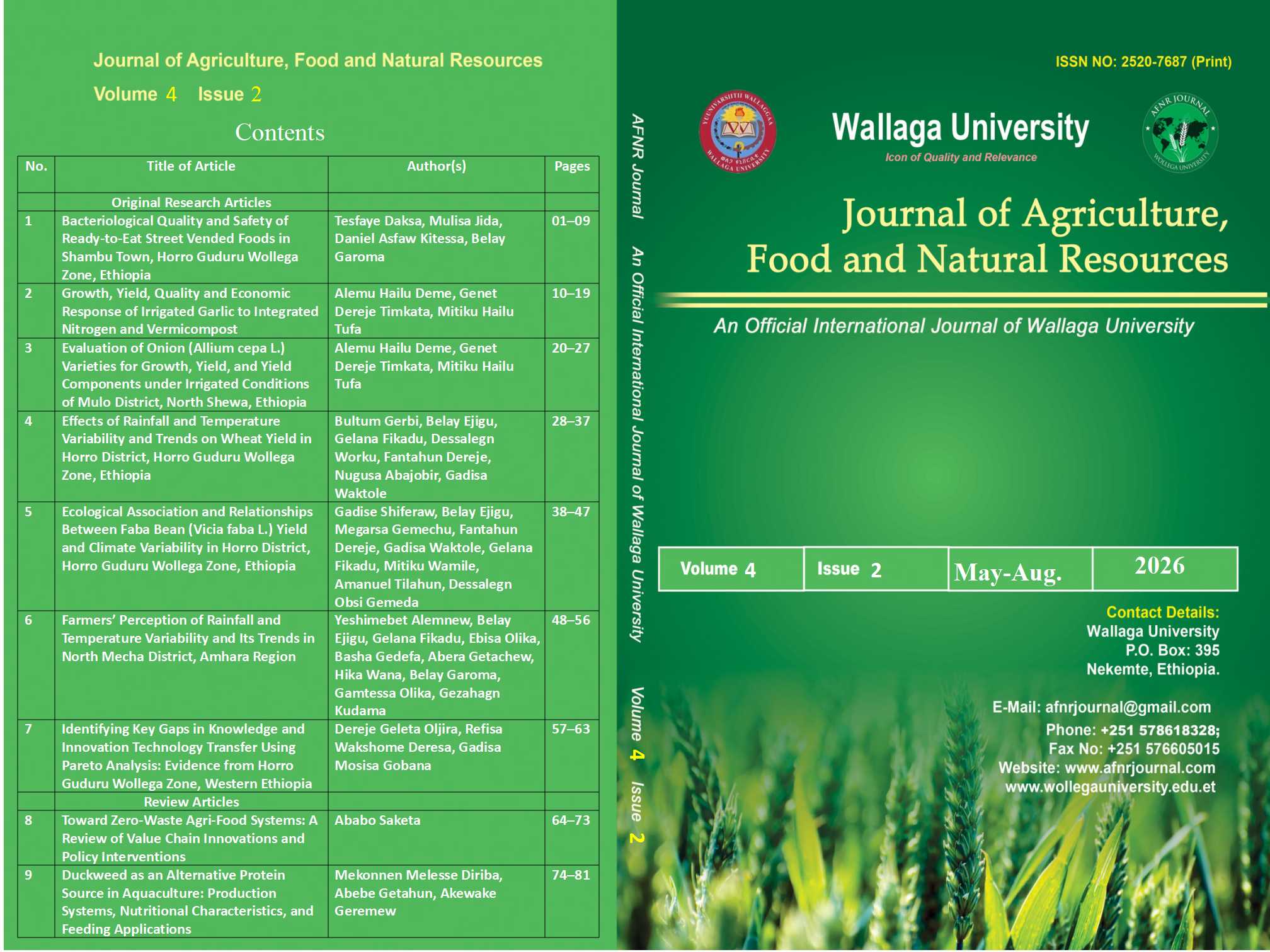
Farmers’ perception of Rainfall and Temperature Variability and Its Trends in North Mecha District, Amhara Region
DOI:
https://doi.org/10.20372/afnr.v4i2.2285Keywords:
Climate Variability, Mecha District, Perception, TrendsAbstract
The study evaluated local farmers’ perceptions of changes in climate conditions and examined historical climatic trends over the 1987–2022 period. A cross-sectional research approach was employed, with participants selected through a multistage sampling technique. Primary data were generated from interviews, focus group discussions, and consultations with key informants-complementary secondary information obtained from agricultural offices, development agents, and the Bahir Dar Meteorological Station. Historical climate records were analyzed using Excel 2016 and XLSTAT version 16 to determine patterns, variability, and trends in climatic conditions. Rainfall fluctuations were quantified using the coefficient of variation (CV) and rainfall anomaly index (RAI). The findings indicated considerable seasonal variability in precipitation, particularly during the Bega and Belg seasons, where CV values reached 37.6% and 32.8%, respectively. Annual rainfall exhibited a decreasing tendency of 4.87 mm per year, while Kiremt rainfall declined at a rate of 3.96 mm annually. Conversely, both maximum and minimum annual temperatures showed increasing tendencies. Mean annual temperature increased significantly by approximately 0.044°C each year (p < 0.05). Consistent with the observed temperature increase and rainfall decline, most respondents across the agro-ecological zones perceived those temperatures had become warmer while rainfall had generally decreased. The results emphasize the importance of developing context-specific climate adaptation interventions that incorporate the socioeconomic conditions and environmental factors shaping farmers’ exposure and vulnerability to climate variability.
Downloads
Metrics
References
Addisu Solomon, Selassie Yihenew G., Fissha, Getachew, & Gedif Birhanu.(2015). Time series trend analysis of temperature and rainfall in Lake Tana Sub-basin, Ethiopia. Environmental Systems Research, 4, 1-12.
Ademe, D., Zaitchik, B. F., Tesfaye, K., Simane, B., Alemayehu, G., & Adgo, E. (2020). Climate trends and variability at adaptation scale: Patterns and perceptions in an agricultural region of the Ethiopian Highlands. Weather and Climate Extremes, 29, 100263.
Alemayehu, A., & Bewket, W. (2017). Local spatiotemporal variability and trends in rainfall and temperature in the central highlands of Ethiopia. Geografiska Annaler: Series A, Physical Geography, 99(2), 85-101.
Alemu, M. M., & Bawoke, G. T. (2020). Analysis of spatial variability and temporal trends of rainfall in Amhara region, Ethiopia. Journal of Water and Climate Change, 11(4), 1505-1520.
Atinkut, B., & Mebrat, A. (2016). Determinants of farmers choice of adaptation to climate variability in Dera woreda, south Gondar zone, Ethiopia. Environmental Systems Research, 5(1), 6.
Belay, A. S., Fenta, A. A., Yenehun, A., Nigate, F., Tilahun, S. A., Moges, M. M., ... & Walraevens, K. (2019). Evaluation and application of multi-source satellite rainfall product CHIRPS to assess spatio-temporal rainfall variability on data-sparse western margins of Ethiopian highlands. Remote Sensing, 11(22), 2688.
Cochran, W. G. (1977). Sampling techniques.john wiley & sons.
Dawit, M., Halefom, A., Teshome, A., Sisay, E., Shewayirga, B., & Dananto, M. (2019). Changes and variability of precipitation and temperature in the Guna Tana watershed, Upper Blue Nile Basin, Ethiopia. Modeling Earth Systems and Environment, 5(4), 1395-1404.
Fox, K. M., Nelson, S., Frankenberger, T. R., & Langworthy, M. (2018). Climate change adaptation in Ethiopia: developing a method to assess program options. In Resilience (pp. 253-265). Elsevier.
Gebrehiwot, T., & van der Veen, A. (2013). Assessing the evidence of climate variability in the northern part of Ethiopia. Journal of development and agricultural economics, 5(3), 104-119.
Hayelom, B., Chen, Y., Marsie, Z., & Negash, M. (2017). Temperature and precipitation trend analysis over the last 30 years in Southern Tigray Regional State, Ethiopia.
IPCC, (2021). Summary for policymakers. In: Masson-Delmotte, V., Zhai, P., Pirani, A., Connors, S.L., P´ ean, C., Berger, S., Caud, N., Chen, Y., Goldfarb, L., Gomis, M.I., Huang, M., Leitzell, K., Lonnoy, E., Matthews, J.B.R., Maycock, T.K., Waterfeld, T., Yelekçi, O., Yu, R., Zhou, B. (Eds.), Climate Change 2021: the Physical Science Basis. Contribution of Working Group I to the Sixth Assessment Report of the Intergovernmental Panel on Climate Change. Cambridge University Press (in press)
Kendall, M. G. (1948). Rank correlation methods.
Lemma, W. A. (2016). Analysis of smallholder farmers' perceptions of climate change and adaptation strategies to climate change: the case of Western Amhara Region, Ethiopia. University of South Africa (South Africa).
Mamu, A. A. (2020). Farmer’s adaptation strategies to climate change and variability in the case of north mecha district, West-Gojjam, Amhara regional state, Ethiopia (Doctoral dissertation).
Mann, H. B. (1945). Nonparametric tests against trend. Econometrica: Journal of the Econometric Society, 245-259.
Mekonen, A. A., & Berlie, A. B. (2020). Spatiotemporal variability and trends of rainfall and temperature in the Northeastern Highlands of Ethiopia. Modeling Earth Systems and Environment, 6(1), 285-300.
NMA (National Meteorological Agency), (2007). Climate Change National Adaptation Programme of Action (NAPA) of Ethiopia: Technical Report, United Nations Development Program (UNDP), NMA, Addis Abeba, Ethiopia.
North Mecha District Administrative Office. (2023). Unpublished administrative report. North Mecha, Amhara, Ethiopia.
Shekuru, A. H., Berlie, A. B., & Bizuneh, Y. K. (2022). Variability and trends of temperature and rainfall over three agro-ecological zones in North Shewa, Central Ethiopia. Arabian Journal of Geosciences, 15(18), 1495.
Suryabhagavan, K. V. (2017). GIS-based climate variability and drought characterization in Ethiopia over three decades. Weather and climate extremes, 15, 11-23.
Tamiru, S., Tesfaye, K., & Mamo, G. (2015). Analysis of rainfall and temperature variability to guide sorghum (sorghum bicolar) production in miesso areas, eastern Ethiopia. International Journal of Sustainable Agricultural Research, 2(1), 1-11.
Tekleab, S., Mohamed, Y., & Uhlenbrook, S. (2013). Hydro-climatic trends in the Abay/upper Blue Nile basin, Ethiopia. Physics and Chemistry of the Earth, Parts A/B/C, 61, 32-42.
Yasuda, H., Panda, S. N., Abd Elbasit, M. A., Kawai, T., Elgamri, T., Fenta, A. A., & Nawata, H. (2018). Teleconnection of rainfall time series in the central Nile Basin with sea surface temperature. Paddy and Water Environment, 16(4), 805-821.
Yohannes, Z., Teshome, M., & Belay, M. (2020). Adaptive capacity of mountain community to climate change: case study in the Semien Mountains of Ethiopia: Z. Yohannes et al. Environment, Development and Sustainability, 22(4), 3051-3077.
Downloads
Published
How to Cite
Issue
Section
Categories
License
Copyright (c) 2026 Journal of Agriculture, Food and Natural Resources

This work is licensed under a Creative Commons Attribution-NonCommercial 4.0 International License.
Journal of Agriculture, Food and Natural Resources
Wallaga University,
All rights reserved.
Accepted 2026-08-30
Published 2026-08-31


