
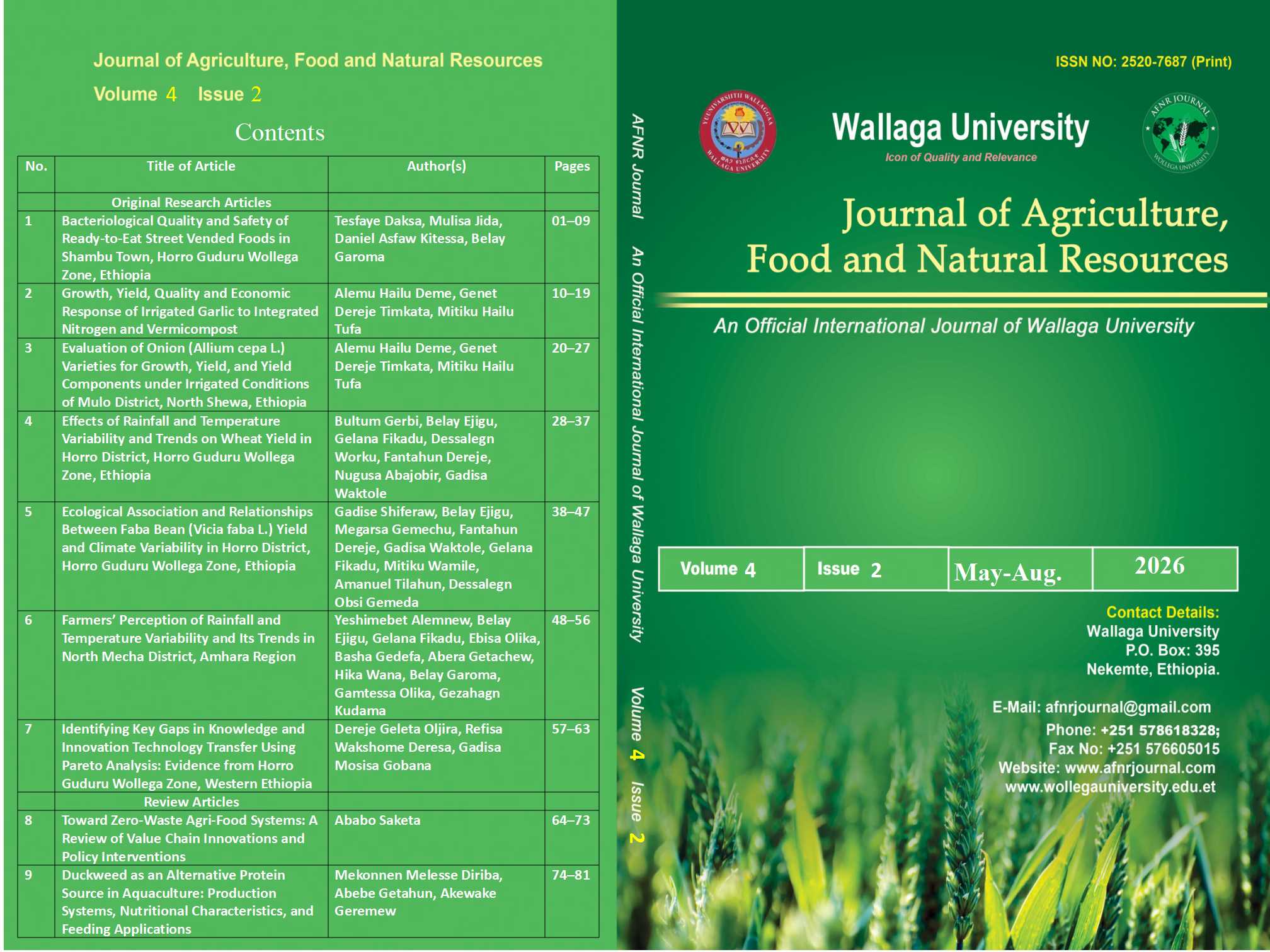
Effects of Rainfall and Temperature Variability and Trends on Wheat Yield in Horro District, Horro Guduru Wollega Zone, Ethiopia
DOI:
https://doi.org/10.20372/afnr.v4i2.2281Keywords:
Climate , Trend , Variability, Wheat, YieldAbstract
This research examined the fluctuations and patterns in precipitation and temperature between 1990 and 2025 and their impacts on wheat yield. Rainfall and temperature historical data acquired from NASA POWER and meteorological records, whereas wheat yield information for 2006–2025 sourced from the agricultural office. Furthermore, information was gathered from 145 randomly chosen wheat-producing households using questionnaires, key informant interviews, and focus group discussions. Descriptive statistics, Mann–Kendall trend evaluation, and Pearson correlation assessment applied to examine the data. The findings indicated upward patterns in maximum and minimum annual temperatures, with rates of about 0.031°C and 0.021°C each year, respectively. In comparison, yearly and seasonal precipitation displayed decreasing trends and significant fluctuations. Belg rainfall exhibited the highest variability (CV = 48.69%), followed by annual rainfall (26.20%) and Kiremt rainfall (18.43%). Wheat production showed a negative correlation with minimum temperature (r = −0.477, p < 0.05) and maximum temperature (r = −0.820, p < 0.01), whereas positive correlations were found with Belg rainfall (r = 0.823, p < 0.01) and Kiremt rainfall (r = 0.399, p < 0.05). Farmers noted rising temperatures, postponed rainfall start, premature end, and erratic rainfall patterns, which adversely impacted wheat yields. The results show that increasing temperatures along with decreasing and inconsistent rainfall are significant climatic factors affecting wheat yield in Horro District. Enhancing climate information, extension services, encouraging heat- and drought-resistant wheat varieties, and advancing soil and water management practices are crucial to boost wheat productivity and farmer resilience to climate variability.
Downloads
Metrics
References
Abebe, G., Tesfaye, K., & Mekonnen, D. (2023). Determinants of climate change adaptation strategies among smallholder farmers in western Ethiopia. Climate and Development, 14(8), 721–733.
Alemayehu, A., & Bewket, W. (2017). Local climate variability and adaptation responses among smallholder farmers in Ethiopia. Environmental Development, 24, 45–58.
Alemayehu, A., Demissie, A., & Tadesse, G. (2021). Climate variability and cereal crop production in Ethiopian highlands. Climate Risk Management, 32, 100299.
Alemu, T., Tadesse, M., & Belay, K. (2022). Effects of temperature and rainfall variability on wheat productivity in Ethiopia. Heliyon, 8(11), e11432.
Asfaw, A., Simane, B., Hassen, A., & Bantider, A. (2021). Determinants of farmers’ adaptation strategies to climate variability in Ethiopia. Heliyon, 7(7), e07595.
Asfaw, A., Simane, B., Hassen, A., &Bantider, A. (2022). Climate variability and temperature trends in northwestern Ethiopia. Climate Services, 26, 100295.
Ayalew, D., Tesfaye, K., &Simane, B. (2022). Seasonal rainfall variability and agricultural implications in the Ethiopian highlands. Climate Services, 28, 100324.
Bekele, W. (2021). Rainfall variability and wheat yield in Southeastern Ethiopia. Journal of Agricultural Science, 13(4), 112-125.
Belay, A., Oludhe, C., Mirzabaev, A., Recha, J. W., Berhane, Z., Osano, P. M., ... & Solomon, D. (2022). Knowledge of climate change and adaptation by smallholder farmers: evidence from southern Ethiopia. Heliyon, 8(12).
Berhanu, W., & Fekadu, B. (2023). Landholding size dynamics and agricultural productivity among Ethiopian smallholder farmers. Agricultural Systems, 206, 103598.
Deressa, T. C., Chalchissa, F. B., & Gemeda, D. O. (2025). Rainfall and temperature variability and trend in the Horro Guduru Wallaga Zone, Northwestern Ethiopia. Environmental Monitoring and Assessment, 197(7), 759.
FAO. (2022). Climate change and agriculture in Sub-Saharan Africa: Impacts and adaptation. Rome: Food and Agriculture Organization of the United Nations.
Gebremariam, K., Bekele, T., & Dibaba, W. (2023). Spatiotemporal analysis of temperature trends in western Oromia, Ethiopia. Environmental Challenges, 12, 100698.
Gebremedhin, B., Jaleta, M., & Hoekstra, D. (2021). Farm plot distance, land fragmentation and agricultural productivity in rural Ethiopia. Journal of Rural Studies, 87, 98–108.
Gizachew, T. G., Belay, W., Worqlul, A. W., et al. (2023). Local and regional climate trends and variabilities in Ethiopia: Implications for climate change adaptations. Environmental Challenges, 13, 100794.
IPCC. (2021). Climate Change 2021: The Physical Science Basis. Contribution of Working Group I to the Sixth Assessment Report of the Intergovernmental Panel on Climate Change. Cambridge University Press.
IPCC. (2022). Climate Change 2022: Impacts, Adaptation and Vulnerability (AR6 WGII). Cambridge University Press.
IPCC. (2023). Climate Change 2023: Synthesis Report. Contribution of Working Groups I, II and III to the Sixth Assessment Report of the Intergovernmental Panel on Climate Change. Geneva, Switzerland.
Kassie, B., Fekadu, G., & Haile, M. (2025). Climate-smart adaptation strategies and wheat productivity among Ethiopian smallholders. Environmental Development, 53, 101089.
Kothari, C. R. (2004). Research methodology: Methods and techniques. New Age International.
Mekonnen, D., & Tadesse, M. (2019). Indigenous climate adaptation strategies among Ethiopian farmers. Climate and Development, 11(6), 505-518.
Mekonnen, M., Kassie, B., & Tadesse, G. (2023). Trends and variability of rainfall in the Ethiopian highlands and implications for smallholder agriculture. Theoretical and Applied Climatology, 153(1–2), 521–536.
Mulugeta, T., Alemayhu, G., Ademe, D., Mohamed, A., Tadele, A., & Kassaye, T. (2026). Spatiotemporal variability and trends in rainfall and temperature and their implications for rain-fed crop production in Wollo and the Oromia Special Zone, Northeastern Ethiopian Highlands. Theoretical and Applied Climatology, 157(4), 220.
Orkaido, G., & Gashure, S. (2026). Adaptation strategies and determinants shaping smallholder farmers responses to climate change in Konso of Southern Ethiopia. Discover Sustainability, 7(1), 360.
Tadesse, T., Fekadu, B., & Haile, G. (2023). Trends in temperature extremes and agricultural impacts in Ethiopia. Theoretical and Applied Climatology, 154, 1179–1193.
Tadesse, T., Haile, G., & Fekadu, B. (2022). Rainfall variability and drought occurrence in Ethiopia: Evidence from long-term meteorological records. Weather and Climate Extremes, 37, 100478.
Tesfaye, B., & Seifu, M. (2023). Socioeconomic determinants of climate adaptation among rural households in Ethiopia. Environmental Challenges, 12, 100703.
Tessema, Y. A., Aweke, C. S., & Endris, G. S. (2022). Determinants of climate change adaptation strategies among smallholder farmers in Ethiopia. Frontiers in Sustainable Food Systems, 6, 842592.
Tessema, Y. A., Endris, G. S., & Aweke, C. S. (2024). Climate-smart agriculture adoption and farm accessibility among rural households in Ethiopia. Environmental Research Communications, 6(2), 025011.
Tufa, K., Negash, M., &Bulti, T. (2022). Spatiotemporal rainfall variability and trends in Oromia Region, Ethiopia. Heliyon, 8(11), e11462.
Downloads
Published
How to Cite
Issue
Section
Categories
License
Copyright (c) 2026 Journal of Agriculture, Food and Natural Resources

This work is licensed under a Creative Commons Attribution-NonCommercial 4.0 International License.
Journal of Agriculture, Food and Natural Resources
Wallaga University,
All rights reserved.
Accepted 2026-08-28
Published 2026-08-31


